Showing posts with label 1975. Show all posts

Sunday, 20 March 2016

A proper gathering...Macellaio's with friends...

This was a very fun lunch. Mr S co-ordinated us and foursome was completed by Zucca Sam, Mr Mann and myself. Having not seen Sam since the closing (not a dry eye in the house) of Zucca it was a long overdue Lunch. We also had Mr Mann's engagement to celebrate. The venue was to be Macellaio in Exmouth market. Not a place I knew. They specialise in sharing plates with a focus on Tuna (aged 7 days) and Beef (aged 7 weeks). It's a fun place.
Everyone brought a bottle or two and away we went. The starting point was Dom Ruinart Rose 1996 which has a bright colour but certainly more tizer than Salon pink, on the nose it was fruited and balanced no real signs of age barring a certain sense of roundness. The palate was generous and a little lush, the parts having fallen nicely into place. We then moved onto Meursault 2008 from Coche-Dury, a refined nose, focussed and very true to 2008 if almost more like Grand Cru Chablis than Meursault in its drive and elegance, very impressive indeed. There was that dash of reduction but no more than that. Long and elegant and certainly a wine to treat like a great red, plenty of air and plenty of time to appreciate it.
My bottle was next - Ausone 1975. A very kind 40th gift last year from a friend and customer who appears in these pages rather a lot. Sam and I are both 1975er's so it seemed a good moment. We decided to pop the cork, it broke but not badly, and pour straight into the four glasses as you never quite know how these older wines will be. We could in fact have been decanted as it got better in glass rather than fading. There was a ferrous smoothness to the palate, the texture of tannins remained but not dryness. The fruit character was darker than you might expect with a definite Cab Franc character at times. Velvety and whilst fully mature not on the way down.
L'Eglise-Clinet 1985 was the second Bordeaux and reminded me, in quality rather than style terms, of a brilliant bottle of the same estates 1989 some years ago. This was a wine that got better and better with air. Soft and voluptuous but in no way lacking definition. Darker fruits initially that got redder and more expressive with time, a wine at it's early peak. Such a treat, exciting!
Now to a more expected region, given this crowd, Barolo. Two vintages of the same wine - Barolo Sarmassa from Brezza. Brezza are a good producer based in central Barolo with good holdings and well worth a visit. On one trip we dropped in for lunch and had some fun as you can see here. The two vintages were a real treat as well - 1990 then the 1989. I felt they performed as you might expect though this was exaggerated by the 1990 having been double decanted with some time and the 1989 just decanted at the restaurant and served. The 1990 had more opulence and more "mass" the 1989 had more drive, vigour and energy, more definition. Less bruised fruit more saline. I like both but you would always pick the 1989 if being fussy. They both have time ahead but as with all the wines here they are mature.

Mr S wasn't that pleased with the other wine he bought but Sam, Tom and I were all happy enough to drink it - Barolo Villero 1978 from Giacosa (white Label) is a wine he knows well. The nose was a little bruised and aged but the palate had a sweetness to add to the slightly grainy texture. An expressive mature Barolo may be not but a good, interesting, glass of aged Nebbiolo, oh yes!
A predictable ending...
From there things became predictably Negroni based before a beer on departure...happy days. Macellaio's I will be visiting again. Chaps...thanks for the bottles and the laughs.

Thursday, 31 December 2015

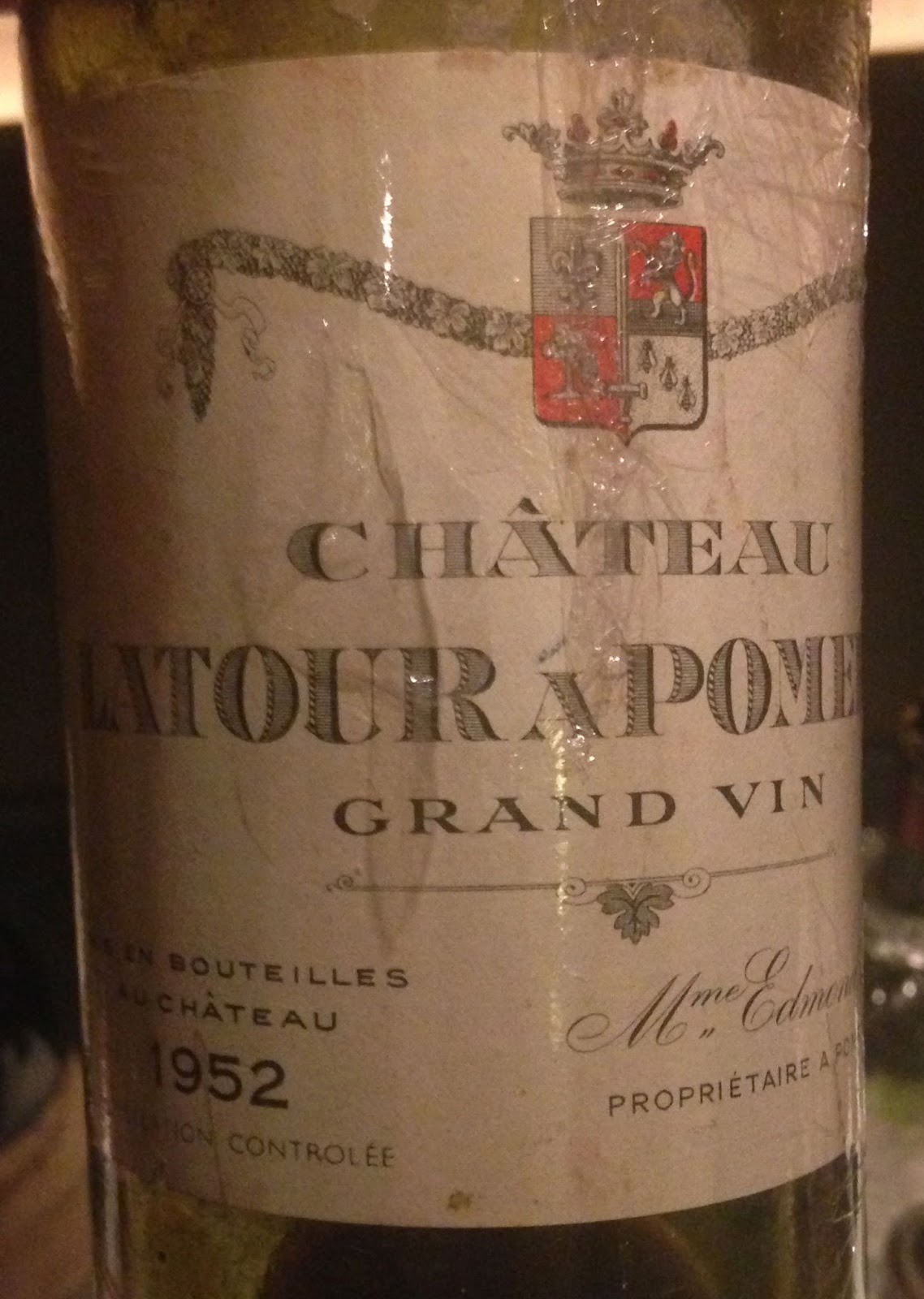
Latour a Pomerol - historic vertical...

After a run of really rather amazing "Jordi dinners" over the last year or so:

I was especially looking forward to this - a very thorough look at the wines of Latour a Pomerol at Les 110 de Taillevent in London with Edouard Moueix in attendance. I have always had a real soft spot for Latour a Pomerol, now yes there might be a commercial edge to that (I work for the agent) but it is more than that. The estate has made several legendary wines. It is part of a very great collection of right bank estates in the hands of ETS JP Moueix. It still somehow seems to fly slightly under the radar. I think this is for a couple of reasons, it is made as a wine to drink, it tastes well when young but is not showy or uber-extracted. People always tend to think that something must be wrong if the legendary wines of the past have not been replicated, not so. I am always excited to open a bottle, even more so a magnum of course, of Latour a Pomerol.

A few stats and background on Latour a Pomerol
7.9 hectares
90% Merlot
10% Cabernet Franc
Two plots: Firstly the nucleus which is 5 ha from the original Clos de Grandes-Vignes located on the central plateau on gravel soils close to l'Eglise St-Jean. The second plot named l'Ecole is located around the Chateau adjacent to La Grave a Pomerol on gravel soils and produces a slightly lighter wine than the first plot.
Production: Around 2500 cases a year, with no second wine

The team at "110" did well with the wines and the full menu can be seen here (a few pics are at the end of the post).


Pate en croute

Foie Gras canape
Mushroom Tartlet Cocktail
-
Duck egg, poached, lardorns, champignos de Paris, baby onions
-
Risotto, creamy with a fricassee of girolles
-
Turbot meuniere, beurre blanc
-
Saddle of lam, roasted with pickled garlic, glove and rosemary
-
Le Vieux Comte, 30 mois d'affinage
-
Petit Fours
I have resisted the temptation to score the wines in this post. I would find it very difficult and therefore it is rather pointless. When comparing a wine that is young (2005) with a wine that is very old (1929) what do you really achieve with scores?

Bollinger started us off as so often at Jordi's dinners, it was rather apt here as the Moeuix family often serve it. R.D. 2002 en magnum was the choice here, very taut and reductive with a little mocha note, clearly will repay considerable time.


The wines were split into logical flights as below:


Recent Vintages

2005 - So full of vibrant fruit with just a dash of saline. Very moreish and alive, voluptuous but with good structure...excitingly good. As with other 2005's this is just starting to "strut it's stuff".

2000 - A little bit of stink, then opens into a wine that is lovely from now onwards, still primary in fruit but with added complexity. I would love to drink this alongside the 2005 in another 5 years. A little spice to finish. Proper!


1998 - A little more savoury and textured, a little iron on the palate . Very moreish indeed. At a lovely point in its evolution - the beginning of the second phase. The quality of the 1998 right bankers is still not really as well known as it should be. Complete. 


1996 - Quite iodine like, with a little meatiness and then a very slight lack of flesh on the palate (the vintage) compared to what went before. Nice to drink now without profundity coming along. More a wine of minerality than fruit. Solid.


1995 - Really good, a vintage that has somehow not had the profile or praise it deserves. There are proper tannins here with the nicely mellowed fruit to contrast. Will age well for sure but good now. Everything as it should be. Classically Pomerol.


Mature Vintages
1990 - Sadly not a perfect bottle. there was a minty volatile edge but then an overly lean and savoury palate. A shame.

1986 - Meaty but also sweet, elegantly developed, pretty and almost fragile. Surprisingly good for such a "Cabernet" vintage. Really like-able.


1985 - Ever so slightly muted nose initially but then this revealed a lovely red-fruited sweetness and lovely moreish (how many times do I have to say this!) texture. This is perfect now, so wonderfully drinkable, preferably in volume! There is the balance to age further by why would you. Just lovely.


1982 - Some iron-like savoury note then almost sweetness, a little blood but with lovely fresh acidity, expressive, extrovert and slightly high-toned.


It was lovely to see the wines so far had almost perfectly translated the general perceptions of the specific vintages. 


Iconic 1970's
1978 en magnum - Volatile, "bricky", harsh and dried out more like 30 year old Sangiovese than Bordeaux. Edouard commented that this was almost exactly what he had expected from this substandard and very dry vintage. 

1975 - Corked (gutted as this is both Jordi and my vintage)


1971 - Stunning, so easy to enjoy, lovely now, so persistently sweet and fine. A cracking Pomerol vintage. Delicious notes of pure ripeness. Supreme...Wow!


1970 - Corked (a real shame as Edouard spoke very highly of good bottles of this)


Transition to ETS JP Moueix
1966 - A little more gritty and grainy and truffled than the 1971. I initially wondered if this might fade in the glass but it did the opposite getting more focused, there is a lovely nuttiness, not normally a positive in reds. There is a sweetness. Very fine.

1964 - Sightly briney, almost a note of bill-tong and pepper, lovely body with good texture and considerable power, a fully mature but not fading wine. Masculine and intriguing.


1962 - Really impressive, fully mature, precise, really lifted, pretty special, almost a mocha note towards the end, stood up well in the glass. A treat.


1961 - Corked, a rather collective sigh, but then one shouldn't meet their heros.

Madame Loubat
1955 - Really lifted, extrovert, superb, manages to be refined in a mellow way at the same time as being unreservedly hedonistic. Is there a better vintage for Bordeaux? My experiences of the 1955 vintage are almost universally spectacular. This was so good that I don't know I would want to have it again, if that makes any sense.
1953 - I think this suffered from following the captivating 1955 because in every other way it was glorious, a little creme brulee richness on the nose. Decadent. 

1952 - Clearly a cooler vintage, bricky and a little lactic, a very slight Bual character, just a well-bred wine that is getting weary.


1949 - Quite high toned and a shade volatile, a little madeirised and delicate.


1945 - Decadent notes, dates in the mix, delicious, good acidity, lifted (the acidity) but also dense, really lovely. 


1937 - Butch and rich but then disjointed not quite sure what this was, very dry and did not really fit with the other wines. 


1929 - High and dry, a little pithy, the palate is clean but totally dried out, rasping. The acidity means it is drinkable but astringent. By all accounts a very small crop with heat in September.


Climens 1942 - Sweet cep nose, mushrooms and brioche, oranges and now quite dry. weirdly would have made a good appetizing aperitif as well as a fascinating ending.

So what would I say in conclusion or summary? Well, Latour a Pomerol certainly has a great past but it is the present and the future that were the learning for me. I think everyone around the table, with the possible exception of Edouard who already knew, was very pleased to see how beautifully the younger vintages drank. Any site that can make wines as brilliant as the 1955 and 2005 but 50 years apart is exciting. There is a grace and elegance to Latour a Pomerol that can almost work against it in terms of standing out around En primeur time or in amongst other showier, glossier wines at tastings. To me Latour a Pomerol remains a very very good Pomerol that portrays the character of a vintage very well and drinks so splendidly...long may it continue! Thanks for the opportunity to taste these Jordi!
Duck egg, poached, lardorns, champignos de Paris, baby onions
Risotto, creamy with a fricassee of girolles
Turbot meuniere, beurre blanc
Saddle of lam, roasted with pickled garlic, glove and rosemary

Saturday, 20 September 2014

Madeira - Blandy's tour and tasting - quite something

To follow on from the previous day, and post, that was all golfing and fun we woke early to get checked out and head on over to the Blandy's wine lodge for a look at the wine making and tour of the Canteiro lofts all follow by a brilliant tasting. I am not going to turn this into a blog about how Madeira is made because that is best left to the experts and there are many good sites on line that cover this including Blandys very own. I'll split this into two halves, the tasting and then a gallery of pictures with a few captions.


Before launching into what was an incredible 29 wine tasting I must just say, in my defence, that the vocab you use for this is difficult, it is so easy for any aroma or flavour that someone mentions to just suddenly appear. These wines are amongst the more complex anywhere and writing about them is, for me at least, difficult so prepare for repetition and unscientific notes. I drink a fair bit of madeira anyway and love the wines which arguably makes them even more difficult to analyse, anyway enough excuses.


This was one of the most enjoyable and informative tastings for some time. Everything was tasted from ISO's and at room temperature. Cask samples are complete wines but incredibly young and obviously will have much time ahead of them for the fortification to meld into the wine etc. The Vindima wines are pre-fortification and from 2014 (coming into the winery as we tasted). For the actual tasting I reverted to an old scoring system of up to three ticks of varying lengths, for this I will try to translate that to "out of 20" with 10 being good to 15 very good and beyond. There are no scores for the Vindima and casks. Right, enough waffle:

Unfinished "wines":
Sercial cask sample - very high acid, piercing even, clean and green with little length.

Verdehlo vindima wine - grapefruit and lemon/lime, very intense, acid high.

Verdehlo cask sample - peary but also oxidised. Very interesting it not yet at a stage where it can be called enjoyable.

Bual vindima wine - grapefruit but with some brown sugar on it, pineapple almost, a touch of pear tannin, good.

Bual cask sample - has a nose of half spirit, half wine, delicious in a savoury complex way, peaty with a saline edge can see why they use this for the whiskies that have a "Madeira cask" finish.

Malmsey vindima wine - pear tannins again but wit a little honey apple acidity, a certain dryness on the finish.

Malmsey cask sample - really needed to meld together, almost the most incomplete now that the spirit is there, a grape of such richness obviously needs time.

Tinta Negra before Estufagem - dates and dry wood aromas almost a little nuttiness, drier palate than I expected.

Tinta Negra after Estufagem - coming together, delicious for the dates and figs then a little odd on the finish.


The Wines:

Alvada - very good, has enough savoury richness to go with the sweetness, fruit is bruised dates and figs has good volume - 14.5.

Sercial 10yr old - lovely nose of nuts but clean and crisp, not heavy, a little white fruit. lovely long dry, tangy finish, impressive - 15.

Verdehlo 10yr old - such a lively and moreish nose, has a lovely bit of dry grip on the palate that is counterbalanced by just enough sweetness. really very good - 16.5.

Bual 10yr old - very classical Madeira, by which I mean archetypal in terms of what ones thinks of Madeira as. A nutty core but with bruised fruits - 15.5

Malmsey 10yr old - not overly sweet on the palate which is good, I might have gone for bual if tasted blind, more dates and figs than any nuts - 15.5. 

Bual 15yr old - concentrated but calm and complete nose, nuts and certainly hazelnuts in the main come to the fore. Very complete - 16.

Malmsey 15yr old - hedonistic, an almost "high" note the the nose, some peatiness as well lush dried fruit intensity, an elegant finish, very good wine - 16.5

Terrantez 20 yr old - tangy, oranges and saline, lovely enticing nose. The palate has a dry energy but this is also a "fruity" wine. Nuts but dark fruit everywhere. It's different somehow but I love it. Herbal even - 17.5  

Sercial 1998 - clean, fine and concentrated, delicious, bright, fresh with a few nuts but more an unctuous "flor" character, could sip this for hours, so different from the previous wine but not better or worse -17.5

Verdehlo 1998 - very bright and lively with an almost citrus fruit, nearly just drank this there and then, high but lovely acidity that keep this so persistent, very focussed and very very long, finish had a nutty tangy my side note just says "great work!" - 18.25. (this may also have been the time when i realised that if, god forbid, I was only allowed one grape from Maderia it would be Verdelho)

Bual 2002 - decadent richness without being overly sweet, a little peat in the middle, potent acidity is good, rich with poise, palate was more open than the nose - 17.25

Malmsey 1996 - some pine resin and a lovely Speyside note here along with sweet fruit on the nose. Texture is rich but not sweet, keeps it's focus well - 17.25

Malmsey 1988 - very fine nose, very complex, hard to describe actually. Yeasty unctuousness with a honeyed element, really very good. I loved the lively and persistent finish that made be think of Verdelho - really pretty special - great all-round Madeira - 18.25

Terrantez 1976 - One of the favourites amongst the team. No lack of interest or complexity, that's for sure. Eucalyptus, medicinal nose, quite herbal, palate similar but lifted, a really tangy acidity, a little smokiness and a slightly degraded animal finish - undoubtedly good, unique…17(+) 

Sercial 1975 - complex, old nose, dry and moreish if a little muted, all about the palate here. The tongue loves this wine, there is a grape tannin and pithy lemon about it my summary is: nose is ok, plate is delicious - 17.5 (first Madeira I've had from my birth year)

Verdehlo 1973 - wow, just beautiful nose, very very complex, hard to describe, tangy on the palate and so lively, then crisp and long a dash of light nuttiness but more a set of dry honey, so good - 18.75-19

Bual 1969 - almost a dash of toffee, very fine, has a nose that suggests even more air would be good (I love the fact that they say with Vintage Madeiras that a day per decade is the best guide for decanting), not too savoury on the nose, Richness on the palate but such a lightness of touch also, very precise the finish is splendid, very high but very good acidity - 18+

Verdehlo 1968 - great nose, almost worthwhile just or the aromas, the finish is then perfect, energy and acidity are brilliant, an incredible vibrancy to this wine, very young and very very tangy, brilliant - 18.75-19

Bual 1920 (bottled 2006) - rich mahogany, has such amazing depth and energy, Nose is decadent, some dates, figs and dark sugary fruits, some savoury edge but mostly real dark energy. there is a brooding and serious side too where Bovril and almost stock appears but then live again, delicious for wallowing in - 18+

Verdehlo 1887 - this was served totally blind and there were a few guesses. I was pleased with my "stab" of Verdehlo 1905. There was a tangy edge that made you unsure if this was sweet or not. Saline is there and such moreishness, very real focus to this, amazing given the age but not amazing for Madeira! Herbal citrus may be the tag line here - 18.5

After this amazing tasting we went to the north of the island to look at vineyards, and with over 400 producers supply the Blandy's team there are a lot of them. The views and countryside is incredible. A great lunch of chicken rice and cabbage with a refreshing Croal beer rounded things of perfectly…it was a real shame to leave the island. Many thanks to Mr Girling, but especially to Chris Blandy and his great team!


Trucks of grapes arrive for inspection and pressing in Funchal
Older vintages, all stood up - the acidity would go through the corks otherwise.
If I remember correctly this is Malvasia.
Nice big barrel of Verdelho.
One of the Canterio lofts, just like the deck of a ship.
Labelled barrels all going through ageing.
Wines resting in demi-johns - sadly under lock and key.
On the north side of the Island - not the worst spot!
The head man - Chris Blandy - inspecting a newly planted vineyard.

Monday, 25 February 2013

Petrus, and a many others, in Yorkshire...

This could be a long write-up as it was a truly momentous day. The southern chapter of this "club" made up of Irish Pete, Chewy and Young Will (that's me...don't ask) made the train journey from King's Cross to Ilkley to meet up with the Northern Chapter - Nobby, Mr G and Ronaldo Mortino. Having dropped a bag in our rooms we convened in the Brasserie of the Devonshire Arms Hotel (recommended) for a light Burgundy luncheon.
Most of the wines through the whole day were served blind or partially so. The white we started with was Bourgogne Blanc 2006 from de Vogue, which by coincidence we had discussed a little on the way up. It is the wine made entirely from the Musigny Blanc Grand Cru site that, due to replanting, has been released as Bourgogne Blanc since 1994. I find it has a unique, oily texture, this was rich, with lime-like acidity and much more to give in coming years. A pair of reds followed and couldn't really have been much more different even if appellation and quality of the vintages might suggest otherwise. First was Vosnee-Romanee 1er Cru “Aux Reignots” 2002 from Sylvain Cathiard which I was delighted about for a few reasons, amongst them the fact that I have heard such great things but also that it is the first Cathiard wine I have drunk. There was a lovely combination of red/black fruit and mulled wine spices but with a precise freshness too, really lovely and whilst it is still a "puppy" it is very enjoyable. The later was Vosnee-Romanee 1er Cru “Beaumonts” 1999, Dominique Laurent - precision and freshness are two words you couldn't really use here. Famed for use of 200% new oak I am not sure what Monsieur Laurent used here but it over powers the fruit and leaves it dry and "exposed". There is no real length and the fruit is stewed. The bottle remained a third full, not because it was actually awful but because there was no charm or fun to be had..a strange wine.
Having eaten well and rested from the journey it was now time for a walk up to Bolton Abbey and a quick cigar for a couple of us - a Quai d'Orsay Corona - a lovely elegant day time smoke that worked well. 
After a quick 15 minute break for the dreaded blackberry we re-assembled for a brief comparative tasting.  The two wines in question being both 2007 and 2008 Gevrey-Chambertin Vielles Vignes from Domaine Roy Marc. This was a nice tasting. The 2008 was the star, an underrated or "insiders" vintage with the 2009 and 2010 over shadowing it. The 2007 was also good but lacked a little of the focus and red fruited character that you expect of 2007, it might just be in a little bit of a phase.
A brief break and then it was pre-dinner Champagne time with a Krug 1995 Magnum, this was rich and very yeasty/biscuity, I would have put it down as being at least 1988 or older such was the intensity. Had we had this with food it would have been a little more balanced I feel but it was most certainly a decadent start to an amazing evening. We then headed off down the road to the Boxtree in Ilkley. I will not dwell on the food much but we were very very well looked after in terms of both service and the food itself so many thanks to Andrew, Didier and the team there. Next on the agenda was the first of 5 blind white wines. Wehlener Sonnenuhr Auslese (Long GoldKap) 1995 from Prum, this was a confusing one as it had a relatively lower acidity, I was a decade or so out and actually went for Rheingau. It was soft and beautifully rounded a great drink and nice now.
From there we were seated and served a Piesporter Goldtropfahen “Feinste” Auslese 1959, Bischofliches Konvikt (J.Harvey and Sons, Fuher 9403) clearly not a wine anyone was going to get spot on!! I guessed Spatlese 1976 but confused the age with a lower ripeness. It was lovely, refined with a classy richness. Now it was white Burgundy time and first was a bottle that was a late addition from one of our hosts, thankfully so as it was delicious. Meursault 1993, Coche-Dury was the wine and the guesses were all Premier and Grand Cru and from more exalted vintages. There was that wonderful Coche character of a struck match and slight edge of reduction. Coche almost never disappoints, there was fruit, structure and a lovely texture to this, for it's "humble" status it was staggering.
The last two whites were served as a pair.  Both were Grand Cru 1992's from Neillon, first Batard-Montrachet and then Chevalier-Montrachet. The character you think of with these two Grand Cru showed perfectly. The Batard a little more extrovert and a little more initially expressive it has shoulders and a more sturdy feel. The Chevalier a dash more refined and a little less showy. The two wines got better and better in glass and opened out. These were very impressive. The 1992 whites remaining slightly under praised those I have been lucky enough to drink have been spectacular.
The wines so far were more than you would dare hope for on even a special wine night but amazingly they were really setting the scene for what was to follow. A Petrus bonanza of sublime proportions. As a warm up to this evening I had read the chapter in Neal Martin's book "Pomerol" on Petrus and I have to say it is a great read, the style works well and gives you information and an understanding without being too intense, recommended. Prior to this evening I had been lucky enough to have tasted 2010 at the En Primeur stage and drunk the 1998, 1990 and 1979 at generously thrown dinners or lunches. On this evening we had 5 vintages with one "imposter" thrown in. The first flight was Petrus 2001, Penfolds Grange 1982 and Petrus 1982. The 2001 was by a long way the youngest tasting 12 year old wine I have ever had. Having to put a vintage on it was very difficult for a few reasons. I knew that the vintage we would be having were all very good ones and I knew there would not be anything overly "young". This left me with a real dilemma as both the intensity and purity fruit were making me think of a very young wine, almost barrel sample young. I plumbed for 2003 thinking about the intensity angle. The 2001 is the year my son was born and so a vintage I have an attachment too it is also generally stunning for, especially, Pomerol. This is a generally magnificent wine, simply brilliant. The Grange was next and whilst the character was very different the texture and class was apparent. Blind I can't remember what we all went for but in retrospect (as always) there was a slight eucalyptus nose with the dark fruit. If you own Grange 1982 you can be very happy. So a legend was next and I am delighted to say that having not excelled on the blind front so far (Irish Pete and Chewy having done better) I nailed this one. Why? well mainly because this was exactly how I imaged (hoped) it would be, the 1982 had expressive and "easy" extrovert fruit combining with the high-toned Petrus liveliness. A simply great wine, so much there and so complex but at the same time so easy to enjoy...a special moment to try a special wine.
The next trio was Petrus 1975, Petrus 1967 and Petrus 1964. I was passed making many notes by now and just enjoying the wines. The 1975 is my birth year and to have this hot on the heels of the 1982 was wonderful. There wasn't the expressive exuberance of the 1982 here or in the rest of the flight as these wines were in the next stage of development. Having said that there is a very definite Petrus character, very much a character and not a style. You get no sense of wines that are "made" just fruit from a great site expressing itself. The 1975 had great balance, a drier type of fruit to the 1982. My notes simply say "very good!". The 1967 and 1964 were both in good condition holding a strong colour. The 1967 had a dark fruit character but with a savoury development as you would expect. The 1964 had a very complete feel and texture with a saline edge to the palate that I liked. It had been a simply amazing two flights of Petrus. The 2001 impressive for its youth and purity, the 1982 for its expression and completeness then the 1975, 1967 and 1964 for their array of more developed and savoury complexities. I will certainly never have all of those again in 0ne sitting.
We were almost done but first Climens 1986 and Yquem 1986 were waiting. It is always compelling to have these two great estates alongside each other and this was no exception. A little like the Batard and Chevalier earlier these performed to type. The Yquem having a little more intensity and more depth, having said this if Sauternes had 5 phases of development this would be only in the second of those phases. There will be a very long life ahead of this. The Climens is a little more feminine, only by comparison, the fruit a little less tropical and the volume turned down a notch... both very fine indeed...
Drinking great wines with great friends is what it is all about in my book and this was exactly how this wonderful day went...it does make the return "fixture" more than a little daunting.

Friday, 25 January 2013

RHR for an Epic

This is going to be one of those posts that I will need to read over and over as I can't quite believe the amazing line up...I have never wanted this to be a show off blog. It is about sharing some opinions on my various hobbies and in this case some very great wines that I was fortunate enough to try. Our generous host knows Royal Hospital Road very well and Clare Smyth, the chef had kindly co-ordinated a menu with Jan the Sommelier (of the year!). So let's get going.
First up was a lovely bottle of Delamotte 1990, fully mature and not with masses of mousse but a delicious bottle that had real poise and balance, not over biscuity but just showing pure bottle age, it worked well with the Risotto and black truffle.
The Whites
Wehlener Sonnenuhr Auslese GK1983 was then the wine to go with a cracking Sweetbreads dish. The wine was at a lovely stage of it evolution, rich marmalade golden orange in colour. The sweetness was not at all overpowering in fact it had started to become more "dried-fruits" in style, it got better and better in the glass, would have been interesting to have had it decanted (I am a massive fan of decanting Riesling). The next pair of wines were fascinating with a simply brilliant truffle linguine. They were Meursault-Charmes 1992 from Lafon and Meursault-Perrieres 2000 from Coche-Dury. Both were in great condition and showed as you would hope. The Lafon was more masculine in style, quite broad but not at all clumsy, very true to Meursault and not showing any signs of tiredness especially in this very fine vintage for whites. The Coche was unsurprisingly spectacular. A genuine wine of the day candidate. I am always waiting to be disappointed by a Coche-Dury but it has, as yet, not happened. Often with wine "expectation is the mother of all disappointments" but not here. The wine was young, with a dash of reduction, I love that, a youthful colour and a lovely gun-flint nose, so refined, grand cru in quality and some. We all savoured the Coche as long as we could.
Linguine to die for...
From a pair of great white Burgundies we moved to red Romanee-St-Vivant 1993 from Leroy
and Romanee-St-Vivant 1991 from Domaine de la Romanee Conti. Now whilst the Coche stole the show a little from the Lafon this was a very fair fight. Both wines were delicious but with different nuances and profiles. The Leroy was the wine with a long long future, a little more taut. Cheesecloth, a little iodine and truffles (we'd eaten enough of them!) then the fruit was kirsh or cherry, lively but not over expressive, a hell of a wine. The DRC by contrast was a more full fruited wine, lashings of red and black fruit with a herbal almost pot pourri element. This is a great time to drink it but it has much to offer into the future too. Both were very much RSV in style with a soft feminine edge but both an absolute joy to drink. Anyone who owns either has themselves a gem. The two vintages are still a little under appreciated, mostly because 1991 & 1993 did not really produce great wines through the rest of France (northern Rhone aside).
The mags...
As Duck, and duck side "salad", made its way out of the kitchen it was Bordeaux-time, both wines being from magnum Petrus 1979 and Lafite 1975. After such amazing Burgundies it was was a worry that the Bordeaux from less stella vintages may struggle to compete but actually as a pair they did well. Both were in good condition and certainly good wines to have in magnum. The Petrus was initially a little closed but fruit came out more and more with a little exotic fruit showing. The seductive Pomerol-round-fruitedness showed more and more. The Lafite  was classically proportioned, a little harder and a little less giving of fruit, slightly drier too. I feel that is too mean a note really but also that it is correct. With little regard to an bias I may have I thought the Petrus was the greater wine but the Lafite showed well.
Tatin-tastic (poor but I can't resist)
With the end of the Bordeaux and then some Taylor 1977 we had a selection of cheeses. The Taylor was so youthful, spiced, still primary, some of this will have been emphasised by the mature wines that preceded it.
The final food and wine pairing was simply brilliant, not rocket science by any stretch but when something works why change - Yquem 1967 and the RHR Tarte Tatin is magic. I have never had the 1967 before and it was stunningly impressive even by the hight standards of Yquem. There was a sweetness and density but neither overpowering, the complexity of the nose and the balance of the palate both being very hard to describe but fabulous to taste. There was a intensely rich and hedonistic Krug Collection 1985 to finish but I was beyond notes at that stage. I do remember think it was very much a food champagne, the Risotto would have worked well and there we are back at the beginning again...
A Epic occasion...
GC...playing "host"