
Menu
Vitello Tonnato
Russian salad Crostini's
Sliced Speck
Vegetable Fritti
-
Pesce Crudo – Monkfish, Crab, Fennel, Sea Bass Carpaccio, Mackerel, Porcini
Radicchio, Artichoke and Fonduta
Carne Cruda
-
Pigeon - heart and liver
Cavolo Nero Ravioli
Taglierini, Pheasant Ragu
Venison, Artichokes and Cocco beans
-
Cheese course
-
Custard Tart, blood orange and yoghurt
The Wines
As is almost always the case at Zucca we started with Ferrari and the 2001, it was savoury, biscuity and more of a food fizz than an aperitif.
So then it was straight into the Rieslings and we decided to start with the Alsatian ones. The 1998 Riesling Jubilee from Hugel was decent. Lemon and lime, lightish, dry but not really that interesting. The next two were both from Zind-Humbrecht, 1994 Riesling Rangen de Thann Clos St. Urbain which was the pick of this first flight for me. Oily, rich, a little orangey and then some dry toffee apple to go with it. The 1988 Riesling Clos Hauserer was a combination of old socks (that can be good in white Bordeaux but not sure elsewhere) and bitter lemon. I remember finding it intriguing start with but it then got a little one dimensional and clumsy. As a trio these were not bad but not exciting either, may be they would have been better served later or just drink better in isolation. I am not that good on Alsace, I should be better.
Right, Germany, oh and one Austrian. Muller kicked us off with 2004 Scharzhofberger Kabinett and it was an electric wake up call after the first flight. My notes simply say "electric, very good indeed, lovely, focussed, clean". The 2006 Niderhuser Hermannshohe Spatlese by Donnhoff was next, alive, opulent, rounded sweetness and unctuousness. The 2006's are like this generally, I think it is a vintage to drink mostly in it's youth for the richness. The 1989 Hattenheimer Pfaffenberg Spatlese from Schloss Schonborn is one of those intriguing wines you can't quite pin down. There was a slight orangey aroma from tiredness but then also speck ham, oily but dry texture and then a note of peppermint tea. Odd but interestingly so. The Austrians joined the party with 2006 Durnsteiner Hollerin Riesling Smaragd from Pichler, a producer who I have had a few things from now and I need to know more. This was good, very pure Riesling but with richness, also a floral side, impressive.
 |
| Ah yes, that'll be the Rieslings! |
Voerzio was up next, it's a producer that tends to divide opinion and with my "traditional only" hat on not one I am that interested in but there is a lot of talk of him going back to a much more traditional way of making wine (from 2009/10 onwards by most accounts). This would be excellent because one thing is not in doubt and that it the ability Voerzio has for growing good fruit. The overall style is quite saturated and fore square. 2007 Barolo Cerequio had a good saline edge to it, not OTT as 2007's can be, it was quite taut and tight, impressive. 2007 Barolo Rocche Del’Annuniata was more lifted, this was a good wine, nice elegant fruit. The 2006 Barolo Brunate was, as expected, less compromising, more savoury, more masculine.
We now went south for 2004 Brunello di Montalcino
Riserva in magnum from Poggio di Sotto it had an almost off dry ripe sweet fruitedness to it, very drinkable, not heavy or light just in a very easy middle ground. The fruit was on the red side and the wine seemed very alive, 60 months in old oak can still leave wines very alive as it does in Barolo. Sadly 2000 Barolo Falletto ‘Le Rocche
del Falletto’ from Bruno Giacosa was corked, gutted!
1995 Barolo Falletto from Giacosa was delicious, the fruit having that lovely bruised character, slightly big and gamey, youthful yet easy, a lovely wine. 1990 Costa Russi from Gaja was a bit of a tart, not a bad thing, treacle-like gravy, heady and opulent in a beef stock and soy style. A little loose and easy, very 1990 to be honest. Then time for what was fairly universally wine of the night (not that it's a competition Sussex!) and this was 1990 Brunello di Montalcino Riserva from none other than Gianfranco Soldera. This wine has everything and as result is actually hard to describe, it it persistent but not heavy, very long but refreshing also, some sweetness but also a lovely savoury balance, exceptional.
1995 Barolo Falletto from Giacosa was delicious, the fruit having that lovely bruised character, slightly big and gamey, youthful yet easy, a lovely wine. 1990 Costa Russi from Gaja was a bit of a tart, not a bad thing, treacle-like gravy, heady and opulent in a beef stock and soy style. A little loose and easy, very 1990 to be honest. Then time for what was fairly universally wine of the night (not that it's a competition Sussex!) and this was 1990 Brunello di Montalcino Riserva from none other than Gianfranco Soldera. This wine has everything and as result is actually hard to describe, it it persistent but not heavy, very long but refreshing also, some sweetness but also a lovely savoury balance, exceptional.
As though one Soldera is not enough we then had his 2004 Brunello di Montalcino Riserva, this wine has a lighter more red fruit profile, it is still very, totally, balanced and refreshing. It is like a more feminine version of the 2006 that I have had a few times now. The partner to this wine was a rather bizarre and intriguing 1995 Cabernet Franc Alzero -from Giuseppe Quintarelli. It is not often that you find "Dime Bars" as a tasting comment on a red wine but they were certainly here along with some other toffeed weirdness and a little coffee but the wine is also off dry and fruited, all rather bizarre, if attractively so.
Back to Riesling with 2009 Wehlener Sonnenuhr Auslese
Goldkap from JJ Prum, what a great palate cleanser. Precise, sweet yes but with focus and real zip. 2005 Niederhäuser Hermannshöhle Auslese Gold Cap from Dönnhoff was a little more evolved and certainly quite opulent. Then 2003 Graacher Domprobst Auslese from Willi Schaefer was a little weird, very appley and a little dryer that you might expect but then 2003's are a weird "bag" generally.
1989 Herrenberg Beerenauslese, Maximin Grünhaus Von Schubert was another opulent expression with clear Tarte Tatin flavours. 1976 Dürkheimer Feuerberg Auslese from Johannes Karst & Söhne, was really quite dry for Auslese and in honesty that is about all my note says, things were getting late!! Alas the 1976 Scharzhofberg Auslese from Egon Müller sadly was corked!
A really wonderful night of delicious wines stunning food and much generosity all round, what next time??!!
 |
| Pesce crudo – monkfish, crab, fennel, sea bass carpaccio |
 |
| Radicchio, artichoke and fonduta |
 |
| Carne cruda |
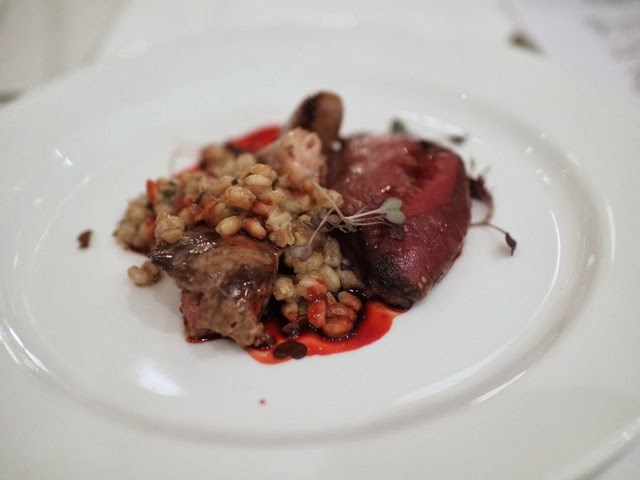 |
| Pigeon, it’s heart and liver |
 |
| Cavolo Nero Ravioli |
 |
| Taglierini, Pheasant Ragu |
 |
Venison, artichokes and cocco beans |
 |
| Custard tart, blood orange and yoghurt |


